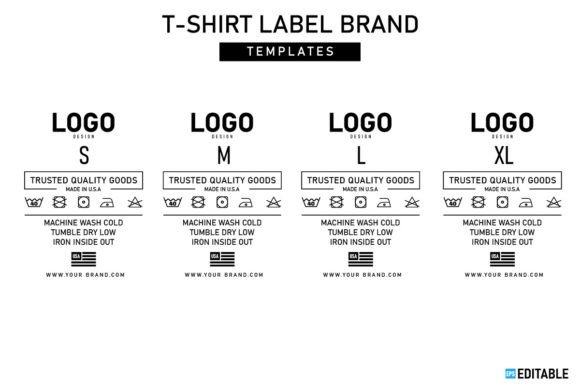
Neck Label Tag Templates: Elevate Your Brand Identity
When someone picks up your garment, the first thing they often feel isn’t the fabric—it’s the brand. That small piece of folded fabric at the collar does more work than most people realize. It’s a handshake, a promise, and a signature all in one. For designers and small business owners, creating that perfect first impression used to mean hiring a specialist or spending hours wrestling with complex software. That’s where high-quality Neck Label Tag Templates come into the picture, offering a bridge between professional design and accessible customization.
The Anatomy of a Professional Neck Label
A neck label isn't just text on a tag; it is a critical component of your brand identity. Visually, the best templates strike a balance between information hierarchy and aesthetic appeal. You are dealing with a very small canvas, usually just a few inches wide. Therefore, the typography used in these templates needs to be exceptionally legible at small sizes. We often see a mix of sans serif fonts for the technical details—like fiber content and care instructions—paired with a script font or a bold display font for the brand name. This combination creates a visual rhythm that guides the eye.
The "personality" of a good neck label template is one of versatility and precision. Whether you are designing for a streetwear line that uses gritty, handwritten fonts, or a luxury silk brand that requires an elegant serif font, the template must adapt. The visual characteristics are defined by negative space. On a label, every millimeter counts. A well-designed template accounts for the "bleed" areas where the fabric will fold and the "safe zones" where critical information must remain visible. It isn't just about decoration; it is about functional packaging design that survives the manufacturing process.
Why Editable Vector Files Matter for Your Brand
You might be wondering why the file format matters so much when you just want to print a tag. The difference lies in scalability and editability. When you purchase design assets like these templates, you aren't just buying an image; you are buying a workflow. These templates come as 100% Vector source files in EPS formats. Unlike raster images (like JPGs or PNGs), vector graphics are based on mathematical paths, not pixels. This means you can scale them up or down without losing quality.
This is crucial for modern typography and branding consistency. Imagine you love the design of your neck label and want to use the same elements for a hang tag, a woven patch, or even social media graphics. With a vector file, you can resize the design to fit a billboard or shrink it down for a tiny cuff label, and the lines will remain perfectly crisp. Furthermore, being 100% editable means you have total control. You aren't stuck with the placeholder text. You can change the font, adjust the kerning (the space between letters), recolor the background, and remove unnecessary elements. This flexibility is vital for anyone serious about logo design and cohesive visual identity.
Practical Applications Across Industries
The utility of these templates extends far beyond just the clothing industry. While they are perfect for t-shirts, hoodies, and denim, the principles apply to any physical product. Here is how different professionals can leverage these assets:
- Fashion Designers & Entrepreneurs: Use the templates to create a standardized look across your entire collection. Consistency in your labeling builds trust and recognition. A premium font choice on a label can subconsciously signal higher quality to the customer.
- Crafters & Hobbyists: If you sell handmade goods on platforms like Etsy, a professional label elevates your product from "homemade" to "handcrafted." It adds a layer of professionalism that justifies a higher price point.
- Marketers & Content Creators: Use the design elements from the neck labels for editorial design or mockups. If you are shooting a lookbook or creating content for web design, having realistic, high-quality label graphics adds authenticity to your visuals.
The versatility of the EPS format ensures that whether you are working in Adobe Illustrator, CorelDRAW, or Affinity Designer, you can manipulate the files to fit your specific needs. You can transform, scale, and add elements without the frustration of pixelation or quality loss.
Integrating Labels into Your Overall Design Strategy
Think of your neck label as a microcosm of your entire brand. The font pairing you choose for your tag should theoretically relate to the typography on your website or your logo. For example, if your brand identity relies on a clean, geometric sans serif font, using a flowery, ornate script on your neck label might create a disconnect.
When evaluating a template, don't just look at the static preview. Visualize it in action. Ask yourself: Does this style match the vibe of my product? Is the text hierarchy clear? Can a customer easily read the size and care instructions? This is where the "test and iterate" phase of design comes in. Because these files are editable, you can experiment with different color palettes. Perhaps a monochromatic scheme fits your minimalist brand, or maybe a high-contrast pop of color is needed to stand out in a crowded market.
Readability and Compliance
One of the most practical aspects of using these templates is ensuring compliance. In many regions, there are legal requirements for what must appear on a garment label (fiber content, country of origin, care symbols). A cluttered or poorly designed label can make this information illegible, leading to returns or customer dissatisfaction. By using a structured template, you ensure that there is enough white space and that the typography is optimized for small-scale reading. It removes the guesswork from the layout process.
Final Thoughts on Professional Presentation
In a saturated market, details are the differentiator. A customer might not consciously notice a perfectly kerned serif font or a well-placed logo, but they will definitely notice if a label looks cheap, blurry, or poorly attached. Investing in high-quality, editable Neck Label Tag Templates is an investment in your brand's perceived value. It allows you to maintain the quality of your creative font choices and ensures that every piece of clothing you produce carries a consistent, professional signature. Whether you are a seasoned designer or a startup founder, having these vector files in your toolkit empowers you to produce retail-ready garments with confidence.